Making Room for the Stories We Keep
Sometimes our homes become the place where we store our stories.
In the South, we love welcoming people into our homes, and we have the china, handwritten recipes, entertainment dishes, and holiday wreaths to prove it. Seriously, lots of wreaths!
Many of those things are family heirlooms, each with a story. As a Baton Rouge professional organizer, I spend a lot of time listening to those stories. Before we can help someone decide what stays, we need to understand why it matters.
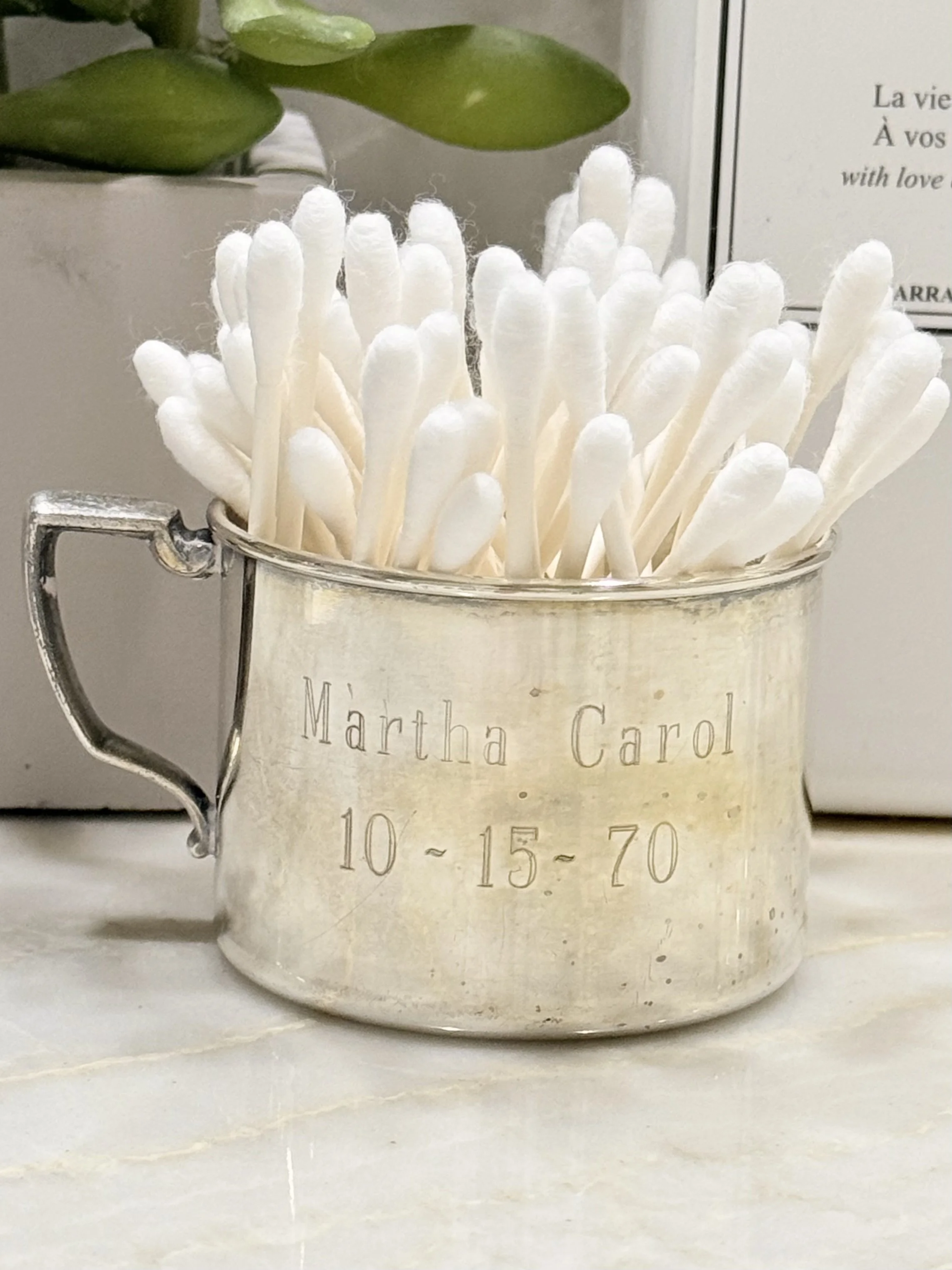
Take a small silver baby cup, for example.
Giving our heirlooms a place in daily life
A silver baby cup might just be a silver baby cup to some people. But to a family, it might be an heirloom that tells part of their story.
We ask our clients to tell us about the cup. Who did it belong to? What memories come with it? Is it something they love or is it “clutter?”
If it is, we find a way to make it functional in their home.
We love using silver baby cups in guest bathrooms to hold cotton balls or cotton swabs. The cup gets to come out of the cabinet and become part of daily life. When a guest notices it and asks about it, the family gets to tell the story behind it.
That is one of my favorite parts of home organizing. Helping people enjoy the things they already own.
But sometimes we have more meaningful things than our homes can comfortably hold. I faced this in my own home with two sets of inherited china.
I inherited the china but not the memories
One set came from my paternal great-grandparents. It was beautiful, expensive, and valuable. But I didn’t know them.
I inherited this china, but did not inherit any memories with it.
The other set came from my maternal great-grandparents. It was less expensive and missing pieces, but it came with so many memories.
My maternal great-grandparents lived with us for the first ten years of my life. I watched television with them. I helped care for them, and they cared for me. I drank coffee milk with my great-grandmother before school in the mornings using that china.
I loved her so much that I chose her grandmother name, Mae Mae, as my own grandmother name with my granddaughter.
I didn’t have room for both sets of china, so I needed to let one go.
Which one?
I gave the beautiful, expensive set to my cousin, who has two daughters. It stayed in the family, which was important to me, and I was happy to share it with her.
I kept the less expensive china because I loved the people and the memories that came with it. That is the china that brings me joy when I see it on my table for Sunday lunch.
Choosing between those two sets helped me understand what mattered to me. The price of the dishes didn’t decide their place in my home. My connection to them did.
Choosing between those two sets of china helped me see what I truly valued. I could appreciate the beautiful, expensive set without needing to keep it. The other set held memories of people I loved, and those were the stories I wanted to carry into my home today.
That is something we help our clients discover, too. What matters to them, and what are they keeping because they feel they should?
Helpful or hurtful
That decision shaped how I help my clients with their own heirlooms.
In our CHAOS Method, H stands for Helpful or Hurtful. We ask whether an item is helpful or hurtful in this season of life.
Helpful doesn’t always mean practical. An heirloom can be helpful because it tells our story.
But do we love it, or do we feel obligated to keep it because it belonged to someone in our family?
Sometimes an object brings a smile before the client even begins telling us about it. Other times, the story comes with guilt, a difficult memory, or the feeling that they aren’t allowed to let it go.
We ask questions. We listen. We pay attention to their reaction.
Sometimes we love aserving platter, but it gets lost in a cabinet stuffed with other entertainment pieces. We can’t see it or easily reach it, so we never use it. Making room in that cabinet allows us to bring out the pieces we truly love and enjoy them with the people gathered around our table.
We help clients decide what belongs in their homes today. Sometimes that means finding a use for an heirloom. Sometimes it means passing it to a relative who would enjoy it. And sometimes a photograph is enough to keep the memory.
We don’t have to keep every object to keep every memory.
The peace goes beyond our front door
When we choose what belongs in our homes, we’re choosing how to tell our story. We make room for the things we love, the memories we want to carry with us, and the people sharing our lives today.
And when those things have a home, everyone knows where to find them and where to put them back. There is less searching, less frustration, and fewer arguments about who moved the keys. We have more time to enjoy being together.
That peace goes with us when we walk out the door. When we spend less time searching for things or worrying about what needs to be done at home, we have more time and energy for the things we love. Lunch with a friend. A hobby we’ve been putting off. Time with our grandchildren. And we get to come home to a place we enjoy.
This is the bigger picture of being organized: a home that tells our story, brings us happiness, and helps us live well, both inside and outside its walls.
It is the vision I shared with fellow organizers at the Second Top World Professional Organizers Conference. Wherever we work, we can help people stand in the doorway of their home and want to be there. We can help people find peace.
There is no shame in a little Southern Chaos.
If you need help deciding what stays and making it work in your home, our Chaos Organizing team offers home organizing services in Baton Rouge. We’ll listen to your stories and help you make room for life today.